EnergySystemBuilder
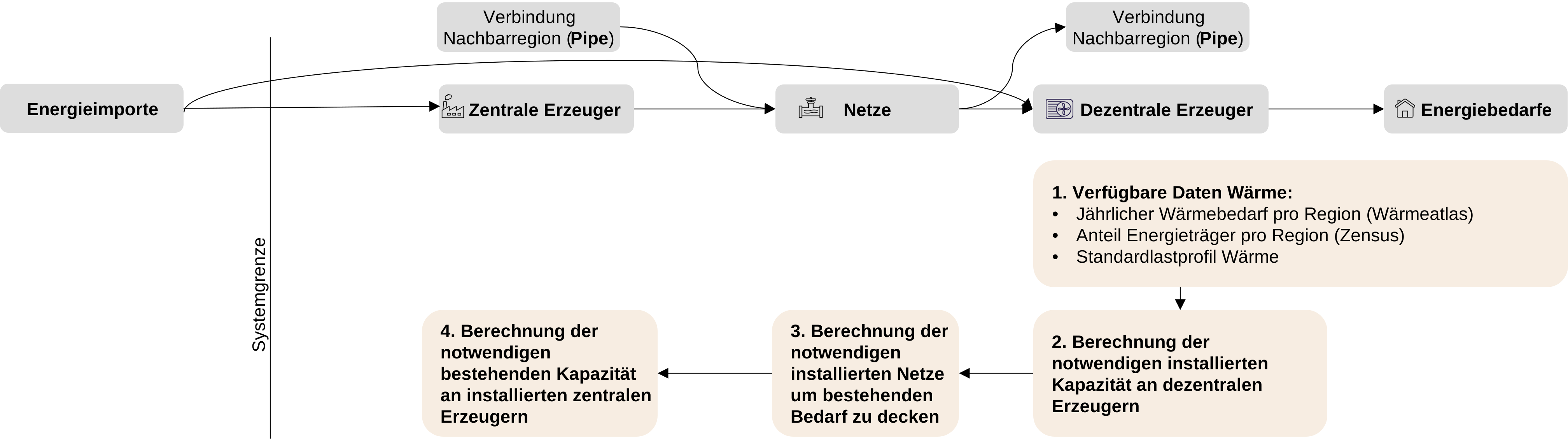
EnergySystemBuilder assembles a fully-specified EnergySystem from a
topology, a DataRegistry, a list of DemandTypes, an imports/exports
file, and an EnergySystemBuilderConfig. The builder uses fluent setters and
a final .build() that returns the assembled system, ready to be
passed to an optimisation backend.
Logic
API
Constructor
EnergySystemBuilder(energy_system_name="Default")
| Parameter | Type | Default | Description |
|---|---|---|---|
energy_system_name |
str |
"Default" |
Identifier of the built EnergySystem; surfaces in reports and plots. |
Setters
| Setter | Type | Required | Description |
|---|---|---|---|
set_system_topology |
networkx.Graph or Topology |
yes | The graph returned by TopologyBuilder.build().network. |
set_data_registry |
DataRegistry |
yes | Registry that resolves the demand values and technology shares. The topology must be built with the same registry (same CRS). |
set_demand_types |
list[DemandType] |
yes | Overwrites the demand list. |
add_demand_types |
*DemandType |
— | Appends additional demand types. |
set_imports_exports |
str or Path |
yes | Path to imports_exports.yaml (see below). |
set_unit |
UnitEnum |
yes | Energy unit of the built system (e.g. UnitEnum.KW). |
set_config |
EnergySystemBuilderConfig |
no | Tuning knobs (see below). Defaults are used if omitted. |
.build() -> EnergySystem assembles and returns the configured system.
Minimal usage
from geopipe.energy_system import EnergySystemBuilder, EnergySystemBuilderConfig
from geopipe.energy_system.units import UnitEnum

builder = EnergySystemBuilder(energy_system_name="Case1")
builder.set_system_topology(topology_result.network)
builder.set_data_registry(data_reg)
builder.set_config(esb_cfg)
builder.set_demand_types([residential_heat_demand])
builder.set_imports_exports("input/imports_exports.yaml")
builder.set_unit(UnitEnum.KW)

energy_system = builder.build()
EnergySystemBuilderConfig
A pydantic model that controls how the builder maps technologies onto the topology. All fields are optional; sensible defaults make a config unnecessary for the smallest cases.
esb_cfg = EnergySystemBuilderConfig(
    minimum_decentral_technology_share={"heat_exchanger": 0.1},
    considered_connected_region_distance_m=50,
    central_tech_locations_per_commodity={"district_heat_in": [0]},
    central_tech_existing_capacities={
        "district_heat_in": {
            0:        [("cen_waste_heat_langnese", 0.6), ("cen_gas_boiler", 0.4)],
            "default":[("chp_gas", 0.8),                 ("cen_gas_boiler", 0.2)],
        }
    },
    additional_grid_capacity_factor={"heat_grid": 1.1},
)
| Field | Meaning |
|---|---|
minimum_decentral_technology_share |
tech_name → float in [0, 1]. Existing-capacity shares below this floor are zeroed (and a warning is logged). |
considered_connected_region_distance_m |
Two regions are treated as a single connected cluster only if their nearest streets are within this distance. Default: unbounded. |
central_tech_locations_per_commodity |
commodity_in → [region_id, …] — which regions may host central techs. If a connected cluster has no entry, the largest-grid region is used. |
central_tech_existing_capacities |
commodity_in → {region_id │ "default" → [(tech, share), …]}. Shares per region must sum to 1.0; "default" is the fallback. |
additional_grid_capacity_factor |
grid_name → factor (e.g. 1.1 = +10 %). Multiplies the existing-capacity bound when grid capacity is propagated through a connected cluster. |
imports_exports.yaml
Defines exogenous commodity supplies (imports: purchased electricity,
gas, biomass, …) and sinks (exports: electricity sold back, …). The
imports key must be present and non-empty; the exports key is
optional and may be omitted entirely. Each is a list of one entry per
commodity:
imports:
  - commodity_out: electricity
    price_eur_per_mwh: 80.0
    co2_emissions_ton_per_mwh:
      0: 0.5
      10: 0
  - commodity_out: biomass
    price_eur_per_mwh: 20.0
    max_cap_per_year: 100              # kW
    max_energy_out_per_year:           # MWh
      0: 500
      10: 1000

exports:                               # optional
  - commodity_in: electricity
    price_eur_per_mwh: -80.0           # negative = revenue per MWh exported
    co2_emissions_ton_per_mwh:
      0: -0.5                          # negative = avoided emissions credit
      10: 0
Imports (required) — required fields: commodity_out,
price_eur_per_mwh. Optional: co2_emissions_ton_per_mwh,
max_cap_per_year, max_energy_out_per_year.
Exports (optional) — required fields: commodity_in,
price_eur_per_mwh (use a negative value to model revenue). Optional:
co2_emissions_ton_per_mwh, max_cap_per_year,
max_energy_in_per_year.
Any numeric field accepts either a scalar or a {relative_year: value}
dict — keys are years counted from the scenario start (0 = first
year).